
Venous access is routine — but it is not always reliable.
– Keano Venner
HEMˣ began with a simple observation.
Every day, healthcare professionals perform blood draws, IV placements, and vascular access procedures under time pressure. In hospitals, emergency care, ambulances, care facilities, and many other healthcare environments, venipuncture is one of the most common procedures.
But common does not mean simple.
The gap between routine and reality
When veins are difficult to locate or access, the process can quickly become painful, stressful, and inefficient.
Repeated puncture attempts affect more than the procedure itself. They can impact:
- Patient comfort and trust
- Staff workload and confidence
- Workflow speed in time-sensitive environments
- Overall quality of care
This is the gap HEMˣ was developed to address.
A routine medical procedure still depends heavily on visibility, experience, patient condition, and environmental factors. In many cases, success is shaped by circumstances that are hard to standardize.
Building toward a more controlled process
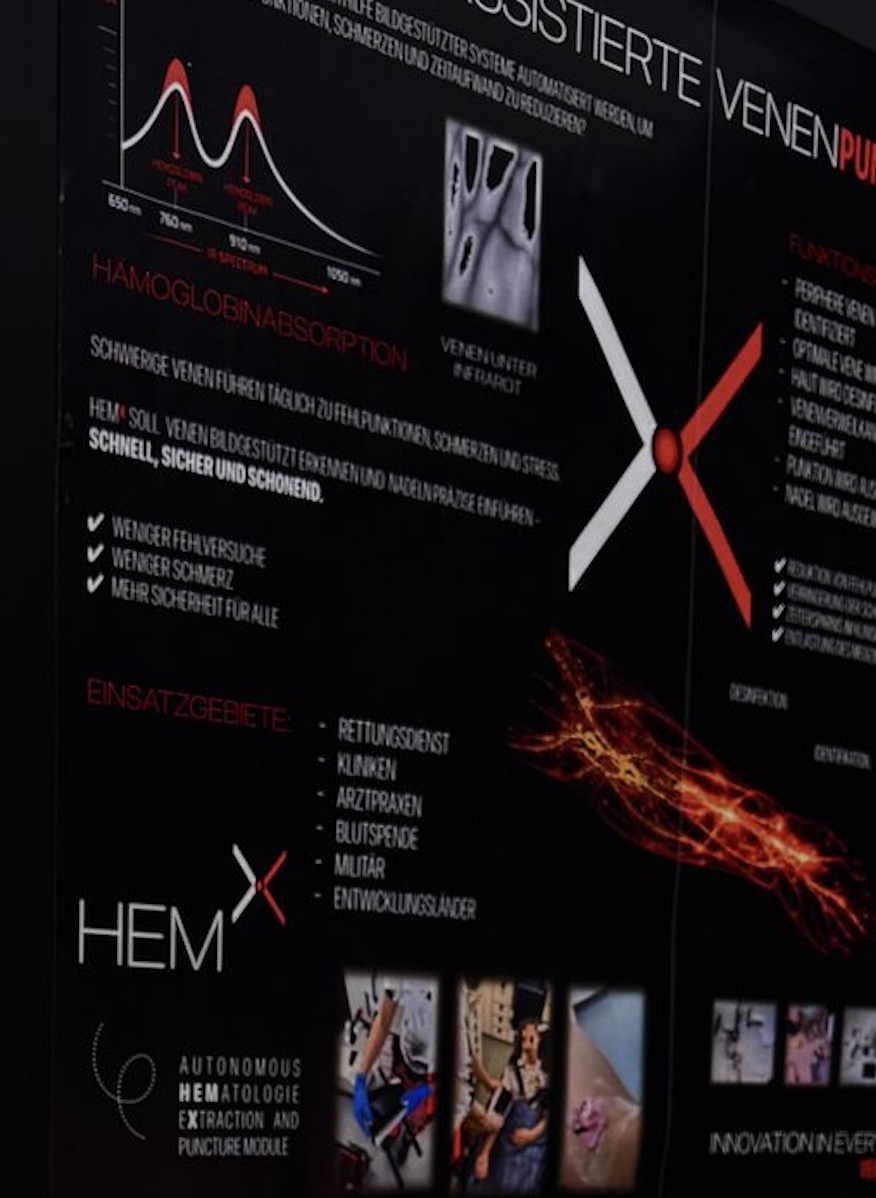
HEMˣ exists to bring more precision and consistency into venous access.
The project combines imaging, automation, intelligent vein selection, and precise mechanical guidance into one integrated approach. Early development focused on turning the concept into a functional system that can detect, evaluate, and approach veins in a controlled way.
From the beginning, the goal was not just to build something technically possible.
The goal was to build something relevant.
Shaped by real-world medical feedback
Conversations with medical professionals helped shape HEMˣ around real-world use.
Their feedback made one thing clear: venous access is not just a technical challenge. It affects patient experience, staff workload, workflow speed, and the reliability of everyday care.
That perspective became central to the development.
HEMˣ is not designed to replace medical judgment. It is being developed to support healthcare teams with a more standardized and reproducible tool — one that can help reduce variability in one of healthcare’s most frequent procedures.
From research-driven innovation to MedTech relevance
This is where research-driven innovation begins to move toward practical MedTech relevance.
For HEMˣ, the transition from idea to system is about more than prototyping. It is about understanding the reality of care environments, listening to professionals, and building toward a solution that can eventually support clinical workflows where precision matters most.
The long-term ambition is clear:
- Fewer failed attempts
- Less patient discomfort
- More confidence in everyday blood access
The next step
HEMˣ is still in development, but the direction is becoming increasingly defined.
What started as a focused technical idea is now evolving into a MedTech initiative built around a real clinical problem — and the belief that one of medicine’s most common procedures deserves a more reliable standard.
This is another step from research to real-world relevance.
– Keano Venner

